Writing
This writing curriculum has been designed by Hales Valley Trust leaders and English leaders, to ensure that it is progressive across the age ranges we teach and is well sequenced and planned.
“Teachers make the education of their children their first concern, and are accountable for achieving the highest possible standards in work and conduct. Teachers act with honesty and integrity; have strong subject knowledge, keep their knowledge and skills as teachers up-to-date and are self-critical; forge positive professional relationships; and work with parents in the best interests of their children.” Teachers’ Standards, 2021.
Definition of teaching
“Teaching is a broad term that covers the many different ways in which adults help young children learn. It includes their interactions with children during planned and child-initiated play and activities, communicating and modelling language, showing, explaining, demonstrating, exploring ideas, encouraging, questioning, recalling, providing a narrative for what they are doing, facilitating and setting challenges.
It takes account of the equipment that adults provide, and the attention given to the physical environment, as well as the structure and routines of the day that establish expectations. Integral to teaching is how practitioners assess what children know, understand and can do, as well as taking account of their interests and dispositions to learn (characteristics of effective learning), and how practitioners use this information to plan children's next steps in learning and to monitor their progress.”
Our intent
It is our intent that children are inspired by high-quality literature and a range of stimuli, which makes readers engage with and enjoy writing. Writing for a variety of purposes and audiences, the children apply progressively more complex skills to communicate ideas fluently and with interesting detail in a range of genres. Vocabulary is also ‘taught not caught’ through demonstration writing and, therefore, the children will have a highly developed repertoire of words using meaning seeking strategies, which extend detail and description. Writing in our school is well-organised and structured, which includes a variety of sentence structures. The children’s excellent transcription skills ensure that their writing is well-presented and punctuated and spelled correctly using their knowledge of spelling patterns and rules. Throughout the writing process, our children will edit and redraft their work, responding to feedback from teachers and peers.
The Curriculum
Statutory requirements
Teaching in the Foundation Stage follows the Communication and Language, and Literacy strands of the Early Years Foundation Stage (EYFS) Framework 2021.
The programmes of study for writing at key stages 1 and 2 are constructed:
-
transcription (spelling and handwriting)
-
composition (articulating ideas and structuring them in speech and writing)
It is essential that teaching develops children’s competence in these 2 dimensions. In addition, children should be taught how to plan, revise and evaluate their writing. These aspects of writing have been incorporated into the programmes of study for composition.
Writing down ideas fluently depends on effective transcription: that is, spelling quickly and accurately through knowing the relationship between sounds and letters (phonics) and understanding the morphology (word structure) and orthography (spelling structure) of words. Effective composition involves articulating and communicating ideas, and then organising them coherently for a reader. This requires clarity, awareness of the audience, purpose and context, and an increasingly wide knowledge of vocabulary and grammar. Writing also depends on fluent, legible and, eventually, speedy handwriting.
Useful links:
The core concepts of writing:
-
Composition
-
Fluency
-
Handwriting
-
Punctation
-
Grammar
-
Spelling
The curriculum is mapped using these core concepts. We plan for progression using the key points outlined in the impact section below. Lesson content is planned towards these progression points and follows a model of direct instruction, shared and modelled practice before culminating in independent practice and mastery. Specific knowledge is acquired through direct teaching, research and the use of technology (where appropriate), to ensure broad and balanced coverage.
Punctuation and Grammar
Teachers follow the National Curriculum for the teaching of punctuation and grammar. Using the Hales Valley Trust Grammar non-negotiables from the Writing Progression Document, the skills are broken down for each year group covering:
-
Word level
-
Sentence level
-
Text level
-
Terminology
This provides the structure for planning individual lessons and a clear progression of skills from Year One through to Year Six. All of these areas are integrated into the teaching sequence. Staff in Years Two and Six can also utilise the CGP revision books for additional tasks to support this learning.
Handwriting
In our schools, we use Nelson or Kinetic Letters handwriting scheme of work to ensure the outcomes our children achieve are the following:
-
Having fluent, legible and speedy handwriting that can be performed automatically, so that working memory is available to focus on the content of the writing.
-
Having the stamina and skills to write at length, with accurate spelling and punctuation.
-
Having competence in transcription (spelling and handwriting) and composition.
-
Writing clearly, accurately and coherently, adapting their language and style in and for a range of contexts, purposes and audiences.
-
Having a comfortable and efficient pencil hold and working position.
Each school in the trust will allocate specific sessions to the teaching of handwriting within the school timetable where handwriting will be taught in discrete sessions, separate from Phonics.
Useful link: National Curriculum English: Handwriting
The Write Stuff Approach
The Write Stuff is based on two guiding principles: teaching sequences that slide between experience days and sentence stacking lessons. As part of the teaching sequence, teachers plan experience days, sentence stacking lessons and independent writing sequences.
“Why write? Writing crystallises your ideas. It preserves them for others. It reveals the facets of your thinking. Good writing is creating a gem for others to discover.”
Jane Considine, The Write Stuff.
The Write Stuff at Hales Valley Trust
At Hales Valley Trust, we have based our teaching techniques and approach on ‘The Write Stuff’ by Jane Considine, to bring clarity to the mechanics of writing. The Write Stuff follows a method called sentence stacking, which refers to the fact that sentences are stacked together chronologically and organised to engage children with short, intensive moments of learning that they can then immediately apply to their own writing.
Writing is centred on a high-quality text that captures the children's interest from the outset. The structure that is used to teach writing is a personalised approach based around best practice taken from The Write Stuff approach and exemplar units. The focus is placed on a love of story, enrichment and language development in order to create highly skilled writers.
Learning to write is a complex process and it is every child’s entitlement. To engage children in writing, we provide purposeful reasons to write where children learn to enjoy writing expressively, imaginatively and informatively for purpose. We make writing part of daily life, linked to play, fictional and real experiences. We encourage the children to develop personal voice, style, stamina and range as a writer as they progress through their school life. We understand that developing children as writers is so much more than asking them to remember grammatical constructions or tricky spellings. It is a complicated and intricate process; by enabling a child to become a writer you have given them a voice, supported them to communicate and provided them with a skill that is vital for all of their life.
Well-planned and sequenced teaching of writing
There are two strategies used within The Write Stuff approach that encourages metacognitive talk and creates a space where language is treasured.
Chotting
Chotting is the process of talking in pairs, where children ‘chat’ and ‘jot’ together to capture their ideas. This strengthens language acquisition, so that children can ‘wring out’ vocabulary and acquire the tools to write.
Kind calling out
Through kind calling out, children can share their ideas openly without the teacher having to ask for hands to be raised, which can slow down the pace of the ‘initiate’ stage of a sentence stacking lesson. This creates an environment where responses are welcomed and children feel confident to engage and participate. Children politely share their ideas and the teacher writes them on the thinking side. Children tune into the words in the room, audit their thinking side and add words to their vocabulary lists so they have a rich reservoir of language. During kind calling out, teachers reject some ambitious vocabulary, verbalising this decision for children and explaining with reference to the purpose/intent of the writing.
When teaching following The Write Stuff approach, it is useful to know what is included in each lesson during the sequence. This section provides guidance on what to include, and how to teach each section. It will also identify your strengths and areas that you may need further professional development.
The sections are:
-
Find the shape (non-fiction)
-
Narrative
-
Experience
-
Sentence stacking
-
Demonstration writing
-
Planning of independent writing
-
Independent writing – begin with the end in mind
-
Editing
-
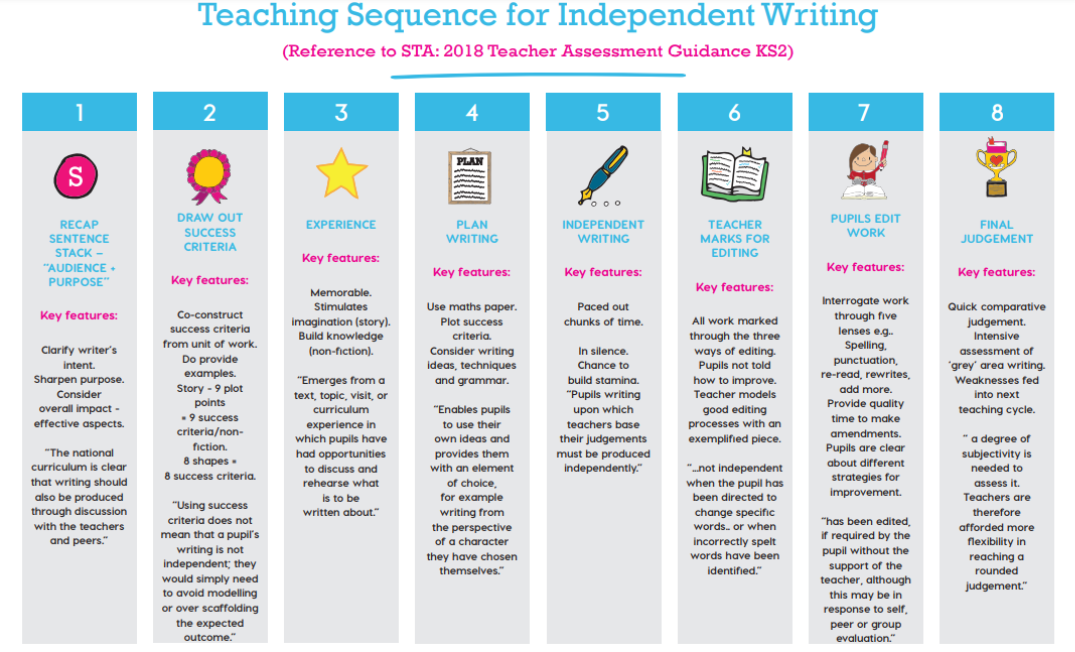
By following the above teaching sequence for independent writing, teachers can avoid the unacceptable outcome of a whole class/groups of children/individuals copying models they have been provided with.
-
Teachers move through the steps to guide children from the highly modelled Sentence Stack to writing independently.
-
The aim is for children to make their own choices as a writer – this will have been modelled to them as the teacher live modelled during sentences stacking whilst narrating their thinking.
-
During the independent writing sequence (and also previously during the sentence stacking sessions), we should aim for divergence (children using the tools provided when following the above sequence to create their own unique writing) as opposed to convergence (children copying a teacher model or rewriting their sentence stacking writing).
-
Teachers should use positive praise to encourage those children who do this, making it a clear expectation that - no two pieces of writing should look the same and celebrating where children have used their sentence stacking writing/working wall/success criteria/inspiration from experience days/their own planning to write independently.
-
Where children have emulated/copied a model rather than innovated – teachers should challenge this by revisiting the independent writing sequence, giving children the opportunity to rewrite their work.
At Hales Valley Trust, we teach English to all children, whatever their ability and individual needs. Through our whole class English teaching, we provide learning opportunities that enable all children to make good progress. We strive to meet the needs of those children with special educational needs, disabilities, English as an additional language and those that are more able. We take all reasonable steps to achieve this.
When progress falls significantly outside the expected range, the child may have special educational needs. Our assessment process looks at a range of factors – classroom organisation, teaching resources, adult support, teaching style and adaptive teaching – so that we can take additional or different action to enable the child to learn more effectively.
Effective assessment against the assessment frameworks in each year group allows us to consider each child’s attainment and progress against expected levels. This ensures that our teaching is matched to the child’s needs.
All children have access to the full range of activities involved in learning English. Where children are to
participate in activities outside the classroom (a theatre trip, for example) we carry out a risk assessment prior
to the activity, to ensure that the activity is safe and appropriate for all children.
Assisting children with specific needs may involve the following:
-
texts that children can more easily read and understand
-
visual and written materials in different formats
-
ICT or other technological aids
-
alternative communication, such as signs and symbols
-
adaptive teaching work
-
adult support
-
learning support interventions
Access to Texts
We support the access to high-quality texts in a variety of different ways:
-
use of ICT and technological aids, for example, ‘read aloud’ function on Microsoft Word
-
use of extra visual prompts e.g., pictures to sequence, media clips to enable greater access to the text
The Thinking Side
The ‘Thinking Side’ can be scaffolded for different groups of children. Teachers use the planning toolkit to create thinking sides to meet the needs of the children within their classes. Children with learning support or individual targets relating to writing should have these areas supported on their thinking side.
Learning Chunks
Where a child has additional needs and they are not able to access the learning chunks in the year group unit plan, adaptations should be made in line with the following process:
Assessment
The following five principles underpin quality assessment. It should be:
-
complementary to and supportive of learning;
-
be valid and reliable;
-
be fit for purpose and manageable;
-
support teachers’ professional judgement; and
-
support accountability
Assessment can serve different purposes according to how we use the information it provides.
-
Diagnostic Assessment
Diagnostic assessment identifies strengths and areas for improvement and informs the next steps. It normally takes place at the beginning of a learning sequence. It involves the teacher working closely with the child to identify their strengths and learning needs. Teachers identify the nature of a child’s difficulties and use this information to plan interventions to address the issues discovered. They should then share this information with the child to plan the next steps to improve their learning.
-
Formative Assessment (Assessment for Learning or AfL)
Formative assessment, often referred to as Assessment for Learning (AfL), is part of the everyday teaching and learning process. Teachers gather evidence about a child’s learning, for example by observing, listening, questioning, discussing and reviewing child work.
They can then use this evidence to:
-
identify progress and gaps in learning (including individual support needs);
-
set learning goals and success criteria; and
-
provide feedback to children.
Progress is tracked using a range of evidence, including teacher observations, outcomes in books and outcomes from written assessments. Teachers and child assess in each lesson against a learning objective/intention/focus, which is linked to the learning chunk in writing. Writing assessment frameworks are used to ensure that judgements are accurate and to inform assessment for learning, identifying children’s areas of strength and points for further teaching.
‘Assessment for learning is the process of seeking and interpreting evidence for use by learners and their teachers to decide where the learners are in their learning, where they need to go and how best to get there.’ - Assessment Reform Group (ARG), 2002
Teachers use AfL to enable children to build on their prior learning. AfL focuses on how children can improve their learning and the continuous process of dialogue and interaction between teachers, children and peers is an essential part.
It involves peer and self-assessment (ARG, 2008; Black and Wiliam, 2009). Ten guiding principles underpin AfL.
It should:
-
-
be part of effective planning;
-
focus on how children learn;
-
be central to classroom practice;
-
be a key professional skill;
-
be sensitive and constructive;
-
foster motivation;
-
promote understanding of goals and criteria;
-
help learners know how to improve;
-
develop the capacity for self-assessment; and
-
recognise all educational achievement.
-
Five key AfL strategies support these ten principles in classroom practice:
-
-
Focus on learning by sharing learning intentions/objectives/focus and success criteria with children.
-
Effective questioning encourages children to think about their learning.
-
Quality formative feedback allows teachers to identify children’ achievements, any gaps in their learning, and areas for further work (what learners have done well and what they should to do to perform better).
-
Scaffolding reflection gives children time to reflect on their learning, allowing them to think about what and how they are learning and to adapt their approaches, if necessary, to achieve their goals.
-
Teacher reflection on effectiveness of teaching and learning allows teachers to verify what their children have learned. This helps them decide what they may need to teach again in a different way, or how to focus future teaching plans.
Summative assessment
-
Summative assessment gives children, parents and teachers valuable information about a child’s overall performance at a specific point in their learning. It provides information about a child’s progress. Summative assessment in the primary school can occur at different intervals such as weekly, on completion of a topic of work, at the end of each term, or at the end of the year. The information it gives indicates child progress and achievement in the knowledge and skills in a particular area of learning, sometimes in grade-related or numerical terms. Short summative assessments can be relevant and valid when they are part of a wider range of assessment methods used to form a holistic picture of each child’s achievements.
Teachers can use this information to inform the next steps in their planning or to highlight gaps in child knowledge and identify areas that they may need to re-emphasise. The information gathered from summative assessment can also be analysed at whole-school level for benchmarking and target setting.
Equal Opportunities in Assessment
The terms ‘equity and fairness are often used interchangeably’ (Stobart, 2005). These terms refer to the idea that assessment should be inclusive and provide all children with equal opportunities to demonstrate their performance and achievements.
To ensure that all children receive consistency in their well-sequenced progressive curriculum. All staff follow the Hales Valley codified approach as set in the Writing Handbook. Deliberately chosen elements have been detailed at the top of this page to enable parents to support their children at home.